Visuals and synsemic writings for more-than-human scenarios
New exploring agents for graphic design
DOI:
https://doi.org/10.82068/pgjournal.2025.22.41.11Keywords:
Agency, Complexity, More-than-human, Visual Writings, Digital NarrationsAbstract
his contribution explores the evolution of digital graphic design beyond an anthropocentric perspective by adopting an exploratory approach that can recount silent natural processes and the intricate relationships between humans and non-humans. This evolution is evident in synsemic writing and visualisations that blend images, text, sound and spatial interaction to transform graphic design into a tangible, multisensory experience. With the advent of digital technology, writing loses its linear, alphabetic nature as text becomes hybridised with images, coding and movement. The sequential nature of information gives way to navigation, connections and relationships.
We analyse a series of visual and synsemic writings as interpretative practices that measure and reproduce
environments, ecosystems and living and non-living subjects, moving from linear to reticular writing. It is no longer just a matter of 'reading' but of 'inhabiting' and, metaphorically, feeling the text and image; experiencing them directly.
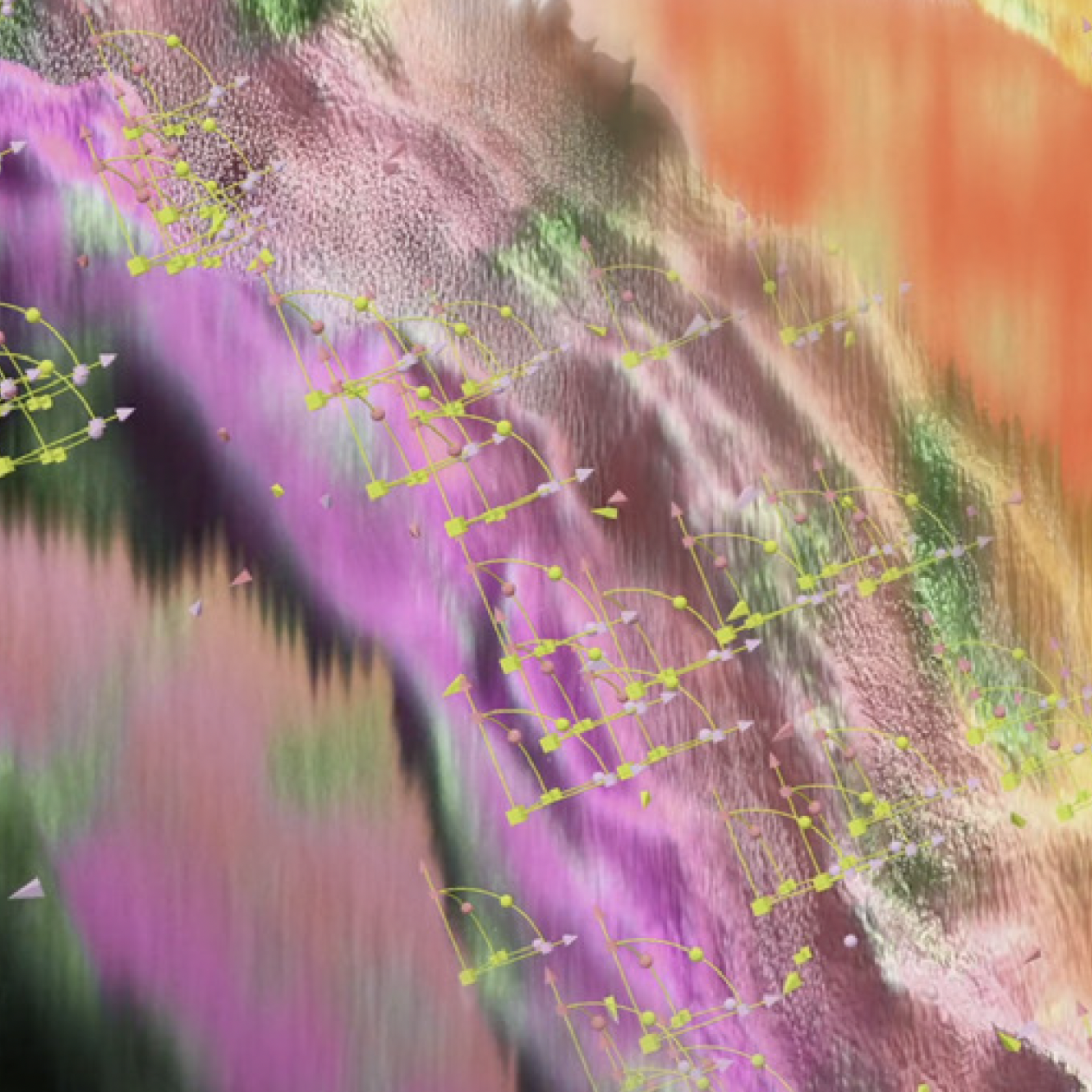
Described as a true geological era recognised for its sudden impermanence, the digital era paradoxically enables us to transcend anthropocentric intentions. This is exemplified by the project Designing with More-Than-Humans, which uses advanced technologies to give a voice to seemingly inanimate elements such as rocks and volcanic landscapes in order to promote anti-hierarchical and interspecies ecological awareness.
This approach culminates in the design of a novel human–nature relationship, translating into visual interactions mediated by hybrid technologies and transdisciplinary immersive experiences. Its ultimate aim is to subvert traditional design logics and promote responsible representation of natural ecosystems, revealing the intrinsic interconnectedness of our lives with the non-human.
References
Akomolafe, B. (2023). Queste terre selvagge oltre lo steccato. Exòrma.
Bocchi, G., & Ceruti, M. (1985). La sfida della complessità. Feltrinelli.
Bolter, J. D. (2001). Writing space: Computers, hypertext, and the remediation of print. Lawrence Erlbaum.
Bonneuil, C. (2025). The geological turn. In The Anthropocene and the global environmental crisis. Routledge.
Bridle, J. (2018). New dark age: Technology and the end of the future. Verso.
Carrasco, J., Carretero, S., Alarcon, A., & Pascual, J. (2022). Algae, Gobiidae fish and insects that inspire coastal custodian entities: Digital models for a real-virtual space using TouchDesigner. In Proceedings of the eCAADe Conference 2022: Co-creating the Future – Inclusion in and through Design (pp. 361–370). https://doi.org/10.52842/conf.ecaade.2022.1.361
Colson, A., & Gross, E.-C. (2024). The algorithmic art: Exploring the intersection of human imagination and AI technology. Ekphrasis. Images, Cinema, Theory, Media.
Costagliola, G., De Rosa, M., Fuccella, V., & Perna, S. (2017). Visual languages: A graphical review. Information Visualization, 17(4), 335–350. https://doi.org/10.1177/1473871617714520
Cukier, K., & Mayer-Schönberger, V. (2013). Big data: A revolution that will transform how we live, work and think. Houghton Mifflin Harcourt.
Escobar, A., et al. (2021). Pluriverso: Dizionario del post-sviluppo. Orthotes.
Floridi, L. (2015). The onlife manifesto: Being human in a hyperconnected era. Springer.
Franchi, F. (2013). Designing news. Changing the world of editorial and information graphics. Die Gestalten Verlag.
Foucault, M. (2011). Spazi altri. I luoghi delle eterotopie. Mimesis.
Haraway, D. J. (2016). Staying with the trouble: Making kin in the Chthulucene. Duke University Press.
Lussu, G. (1999). La lettera uccide. Stampa Alternativa & Graffiti.
Manovich, L. (2001). The language of new media. MIT Press.
Morton, T. (2021). Ecologia oscura: Logica della coesistenza futura. Luiss University Press.
Naess, A. (2021). Siamo l’aria che respiriamo. Saggi di ecologia profonda. Piano B.
Palmieri, A., & Cirafici, A. (2024). La dismisura nella rappresentazione degli elementi naturali: Dinamiche dell’osservazione tra micro e macro visioni. In F. Bergamo et al. (Eds.), Misura / Dismisura. Proceedings of the 45th International Conference of Representation Disciplines Teachers (pp. 3409–3428). FrancoAngeli. https://doi.org/10.3280/oa-1180-c643
Pan, Z., Pan, H., & Zhang, J. (2024). The application of graphic language personalized emotion in graphic design. Heliyon, 10(9). https://doi.org/10.1016/j.heliyon.2024.e30180
Perondi, L. (2012). Sinsemie. Stampa Alternativa & Graffiti.
Perri, A., Perondi, L., & Capo, D. (2024). Rethinking Unicode: How to digitally encode non-linear written artefacts? A tentative encoding of Codex Mendoza, folio 2r. Conference Grapholinguistics in the 21st Century. (Manuscript under review).
Perri, A., Perondi, L., Capo, D., Arista, R., & Dalai, G. (2024). Alternative graphemics: Aztec writing system as a case study towards an integrated, digitalised model of non-typographic graphemics. Ocula, 24(30), 43–64.
Ranzo, P., & Scarpitti, C. (2024). Per un design more-than-human: La condizione digitale e l’estetica post-antropocentrica. GUD – Genova University Design, 9. Stefano Termanini Editore. https://www.stefanotermaninieditore.it/portale/gud-design-2/gud09-01_2024-iperumano-hyperhuman/
Downloads
Published
Issue
Section
License
Copyright (c) 2025 Progetto Grafico Journal

This work is licensed under a Creative Commons Attribution-NonCommercial-ShareAlike 4.0 International License.