DESIGNING COEXSTIANCE
SALENTINO GREEK AS A CRITICAL SPACE FOR MULTIGRAPHICISM DESIGN
DOI:
https://doi.org/10.82068/pgjournal.2025.22.41.19Keywords:
salentino greek, multigraphicism design, keyboard, typographyAbstract
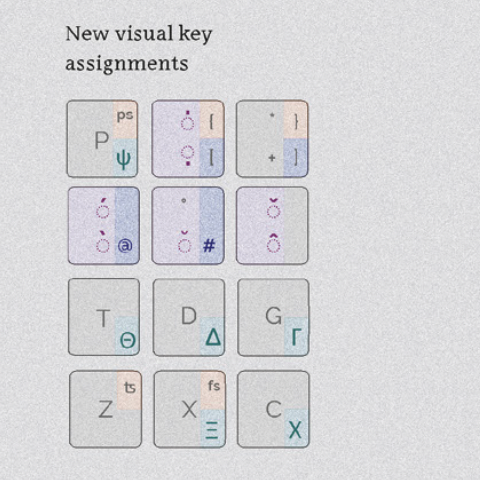
Italian keyboards do not include Greek characters or the necessary diacritics, rendering digital writing fragmented and inefficient. The result is a reduced and standardized representation of the language, modeled on dominant Italian writing. The introduction of a multiscript digital keyboard for Salentino Greek constitutes a concrete critical design proposal. It addresses the issues of the marginalization of Greek letters in recent lexicographies and the lack of typographic and digital support, which imposes incoherent transliterations. The project resolves these problems, enabling the alternation and coexistence of Greek and Latin characters for more accurate phonological representation. Methodologically, the keyboard is a conceptual prototype developed on the characters of Salentino Greek writing, currently under experimental testing and subject to revision. It is not merely a theoretical simulation but a model testable on open-source keyboard-mapping platforms.
References
Baglioni, D., & Tribulato, O. (Eds.). (2015). Contatti di lingue – Contatti di scritture: Multilinguismo e multigrafismo dal Vicino Oriente Antico alla Cina contemporanea [Language contacts – Script contacts: Multilingualism and multigraphism from the Ancient Near East to contemporary China]. Edizioni Ca’ Foscari - Digital Publishing.
Greco, A. (2003). Ivra tin Glossamu: Grammatica Grika della Grecìa Salentina [Ivra tin Glossamu: Griko grammar of the Grecìa Salentina]. Besa.
Kigelia Font. (n.d.). Kigelia font: Multigraphic project for West Africa. Retrieved from https://www.kigeliafont.com/
Lambrinos, S. (2001). Il dialetto greco salentino nelle poesie locali: Testi, note grammaticali, vocabolario etimologico [The Salentino Greek dialect in local poems: Texts, grammatical notes, etymological vocabulary]. Amaltea.
Leonidas, G. (2013, October 15). Going global: The last decade in multi-script type design. In S. Coles (Ed.), Typographica. Retrieved from https://typographica.org/on-typography/going-global-the-last-decade-in-multi-script-type-design/
Leonidas, G. (2023). Identifying patterns in the globalisation of typeface design. Zhuangshi: Chinese Journal of Design, 358(2), 12–17. https://centaur.reading.ac.uk/119940/
Lupton, E. (2024). Thinking with type: A critical guide for designers, writers, editors and students. Quinto Quarto Edizioni.
Ministero dell’Istruzione, dell’Università e della Ricerca. (2018). Minority languages. Retrieved June 26, 2024, from https://www.miur.gov.it/lingue-di-minoranza-in-italia
Matteson, S. (2020, August 31). The road to Noto [Video]. TeX Users Group. YouTube. https://www.youtube.com/watch?v=HHIFL7DxOP0
Palma, D. (2023). Loja Danikà – “Esempi di osmosi linguistica e rituale” [Loja Danikà – “Examples of linguistic and ritual osmosis”]. L’I-DomenEO, 36, 103–108. https://doi.org/10.1285/i20380313v36p103
Palma, D., & Palma, G. (2019). El Turcho in terra d’Otranto: Lo sciame Bellicon dal 1480 al 1816 [El Turcho in the land of Otranto: The Bellicon swarm from 1480 to 1816]. Kurumuny.
Parekh, B. C. (2002). Rethinking multiculturalism: Cultural diversity and political theory. Harvard University Press.
Tommasi, S. (1996). Katalìsti o Kosmo: Tra passato e presente [Katalìsti o Kosmo: Between past and present]. Editrice Salentina.
Typotheque. (2024). Zed: A type system for information accessibility. die Keure.
UNESCO. (2021, February 18). UNESCO and linguistic diversity: The case of Italy. Retrieved from https://www.unesco.it/it/temi-in-evidenza/educazione/lunesco-e-la-diversita-linguistica-il-caso-dellitalia/
UNESCO. (2022, February 1). The International Decade of Indigenous Languages (2022–2032). Retrieved from https://www.unesco.it/it/news/ildecennio-internazionale-delle-lingueindigene-2022-2032
UNESCO. (2021). Global action plan of the International Decade of Indigenous Languages (2022–2032). United Nations Educational, Scientific and Cultural Organization. https://unesdoc.unesco.org/in/documentViewer.xhtml
Watzlawick, P., Beavin Bavelas, J., & Jackson, D. D. (1978). Pragmatics of human communication: A study of interactional patterns, pathologies and paradoxes. Norton. (Original work published 1967). (trad. it. Pragmatica della Comunicazione Umana. Astrolabio, 1978.)
Zegler, L., Dykes, J., & Wood, J. (2022). Participatory data physicalisation as a creative method for inclusive data engagement. The Design Journal, 25(1), 1–22. https://doi.org/10.1080/14606925.2022.2048080
Zimmerman, J., Forlizzi, J., & Evenson, S. (2007). Research through design as a method for interaction design research in HCI. In Proceedings of the SIGCHI Conference on Human Factors in Computing Systems (pp. 493–502). https://doi.org/10.1145/1240624.1240704
Downloads
Published
Issue
Section
License
Copyright (c) 2025 Progetto Grafico Journal

This work is licensed under a Creative Commons Attribution-NonCommercial-ShareAlike 4.0 International License.