History as a necessary condition for knowledge
Editorial PGJ43
DOI:
https://doi.org/10.82068/pgjournal.2026.23.43.01Abstract
We have waited for the third issue of the new Progetto Grafico Journal to address a topic currently at the
heart of scholarly debate across numerous established disciplines—as well as new fields that have emerged
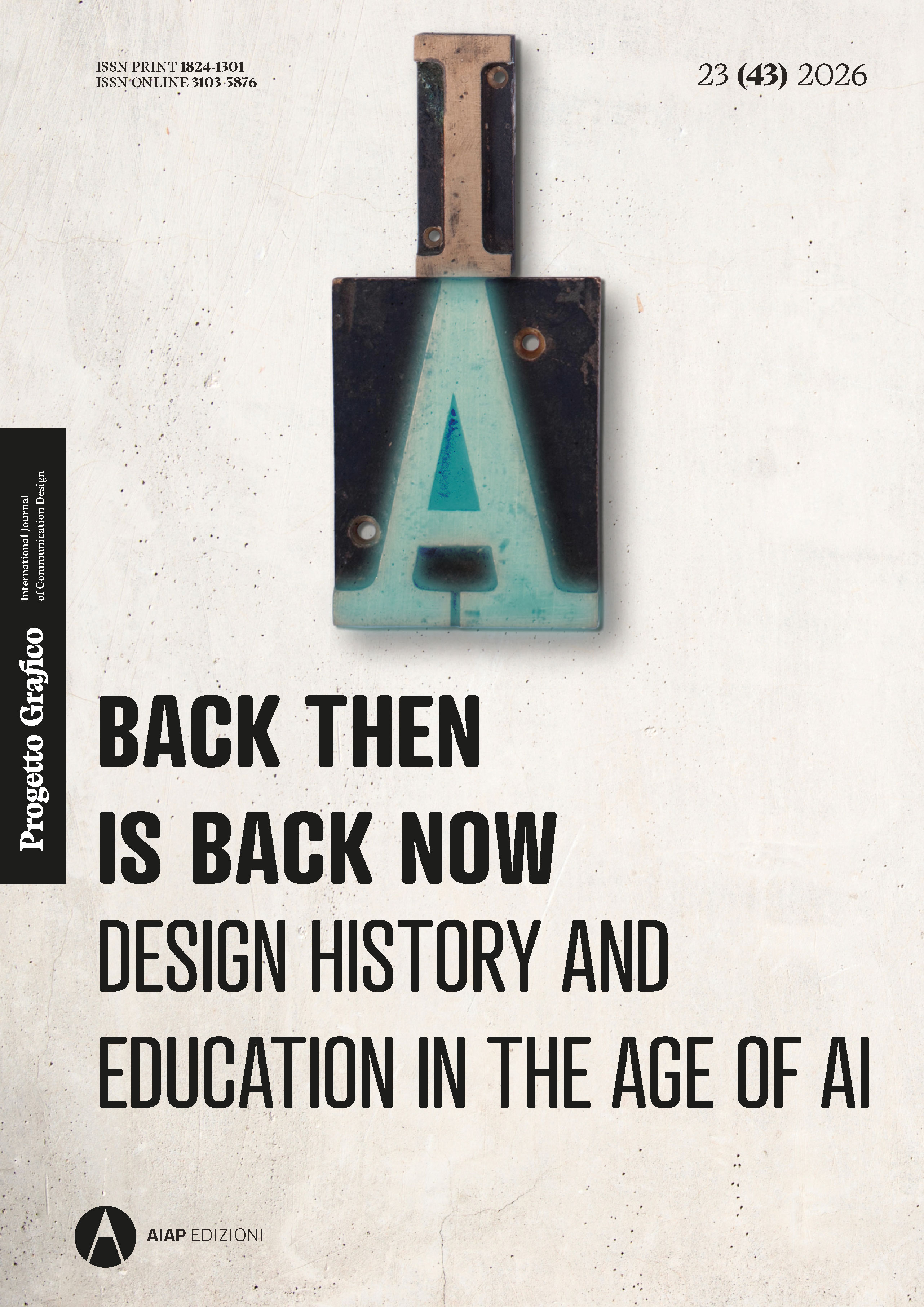
in response to this development (such as philosophy of information, ethics of technology, etc.) and, specifically, within the field of communication design: the role of design education in the age of Artificial Intelligence. More precisely, following a proposal by Michael Stoll, we focus on the role of history in the education of communication designers. This reflection holds strategic significance within the journal’s scholarly context and contributes to a conversation in which many educators and researchers wish to participate, aiming to update their perspectives and dispel the doubts and uncertainties sparked by the advent of AI.
References
Benanti, P. (2026). La nuova logica del dominio. Potere computazionale, democrazia e condizione umana. Giuseppe Laterza & Figli.
DeTroy, H. (2026). Design authorship in the AI age. NC State News. https://news.ncsu.edu/2026/01/design-authorship-in-the-ai-age/Ferraris, M. (2025). La pelle. Che cosa significa pensare nell’epoca
dell’intelligenza artificiale. Società Editrice Il Mulino.
Filippini, A. (2026). Immagini che parlano. Il racconto iconografico per la storia del design. AIS/Design Storie e Ricerche, 24(13), 54-69. Floridi, L. (2025) La differenza fondamentale. Artificial Agency: una nuova
filosofia dell’intelligenza artificiale. Mondadori.
Floridi, L. & Lovecchio, M. (2026). L’Italia nell’era dell’IA. Crescita, Sfide e prospettive di una rivoluzione in corso. Edizioni Fondazione Leonardo.
Forty, A. (1992). Objects of Desire: Design and Society since 1750. Thames & Hudson.
Klingberg, T. & Wikforss, A. (2026). Perché imparare se le macchine sanno già tutto? Giangiacomo Feltrinelli Editore.
Manovich, L. (2019). AI Aesthetics. Strelka Press.
Margolin, V. (2002). The Politics of the Artificial: Essays on Design and Design Studies. University of Chicago Press.
Martino, C. (2024). Design e rivoluzione digitale. Nuove opportunità per una formazione consapevole. In F. Tosi, C. Martino, P. Ranzo, P. Tamborrini & F. Zurlo (eds.), La formazione universitaria del Design nel cambiamento d’epoca (48-53). Rubbettino Editore.
Papa Leone XIV (2026). Magnifica Humanitas, Lettera Enciclica sulla custodia della persona umana nel tempo dell’intelligenza artificiale. Libreria Editrice Vaticana.
Somaini, A. (2023). Algorithmic Images: Artificial Intelligence and Visual Culture. Grey Room, 93, 74–115. https://doi.org/10.1162/grey_a_00383
Downloads
Published
Issue
Section
License
Copyright (c) 2026 Progetto Grafico Journal

This work is licensed under a Creative Commons Attribution-NonCommercial-ShareAlike 4.0 International License.