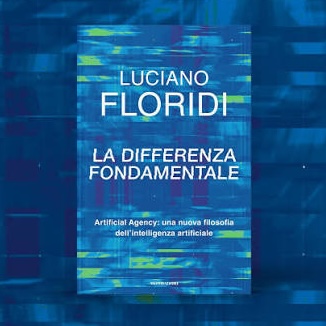
La Differenza Fondamentale
Artificial Agency: una nuova filosofia dell'intelligenza artificiale (Floridi, 2026)
DOI:
https://doi.org/10.82068/pgjournal.2026.23.43.15Abstract
There is a recurring temptation in the literature on artificial intelligence to take extreme positions: either emphasising its benefits or dramatising its dangers. Luciano Floridi, founder of the philosophy of information and of the concept of the infosphere, takes a third path – more uncomfortable and more fertile. The Fundamental Difference proposes
a shift in perspective: to stop asking whether AI is intelligent and begin understanding it as a new form of agency, that is, the capacity to act in the world effectively and successfully, in the complete absence of intelligence. The author presents the volume as a natural complement to The Ethics of Artificial Intelligence (2023).
References
Floridi, L. (2023b). AI as Agency without Intelligence: On ChatGPT, Large Language Models, and Other Generative Models. Philosophy & Technology, 36(1), 15.
Floridi, L. (2023a). The Ethics of Artificial Intelligence: Principles, Challenges, and Opportunities. Oxford University Press.
Floridi, L., & Chiriatti, M. (2020). GPT-3: Its Nature, Scope, Limits, and Consequences. Minds and Machines, 30(4), 681–694.
Manovich, L. (2026). A Medium That Thinks: Generative AI and Media Cognition. Emerging Media, 4(2), 225–232.
Shannon, C. E., & Weaver, W. (1949, repr. 1998). The Mathematical Theory of Communication. University of Illinois Press.
Somaini, A. (2023). Algorithmic Images: Artificial Intelligence and Visual Culture. Grey Room, 93, 74–115.
Downloads
Published
Issue
Section
License
Copyright (c) 2026 Progetto Grafico Journal

This work is licensed under a Creative Commons Attribution-NonCommercial-ShareAlike 4.0 International License.