The Sleep of Vision Produces Monsters
The Sleep of Vision Produces Monsters. Constructing the Gaze and Politics of Imagination
DOI:
https://doi.org/10.82068/pgjournal.2026.23.42.04Keywords:
Collective Imaginary, Scopic Regime, Visual Culture, Western Gaze, Visuality, IrrationalAbstract
The way a community observes and interprets reality, its scopic regime, is a socially constructed phenomenon. What we perceive is neither neutral nor self-evident, but is made possible by a network of practices, devices, and tools that define what can be seen and understood in relation to specific historical and socio-economic conditions. Adopting a theoretical-critical approach, this paper aims to examine the role of images in shaping the contemporary gaze from an interdisciplinary perspective that intertwines communication design with art history, visual culture, philosophy, and anthropology. Within the current mediascape, the construction of the collective imaginary has been progressively delegated to the market, which shapes its forms, languages, and desires. By highlighting the role of images as devices capable of orienting emotions, beliefs, and behaviors, this analysis traces a trajectory extending from the biological and subjective dimensions of visual perception to contemporary media regimes. In response to the commodification of vision, this study points to a revaluation of the irrational, positioning artists and designers as catalysts for new imaginaries and recognizing the automation of machines as an ally capable of relieving human beings of the constraints of technical labor.
References
Barthes, R. (1980). La chambre claire: note sur la photographie. Éditions de l'Étoile, Gallimard, Le Seuil.
Bataille, G. (1949). La part maudite: essai d'économie générale. Les Éditions de Minuit.
Baudrillard, J. (1981). Simulacres et simulation. Éditions Galilée.
Baxandall, M. (1978). Painting and experience in fifteenth-century Italy: a primer in the social history of pictorial style. Oxford University Press.
Berardi, F. (2011). Futurabilità. Nero Edizioni.
Bloch, E. (1986). The spirit of utopia. Stanford University Press.
Bregman, R. (2017). Utopia for realists: how we can build the ideal world. Little Brown & Company.
Brizioli, A., Milani, C., Lorenzo, R., Fofi, G., Giacchè, P., Trocchi, A., Boni, S., C.I.R.C.E. (2025). Lezioni di anarchia: spazio e anarchia, vol. 2. Emergenze Publishing.
Ciaponi, F. (2025, September 13). Estetiche rotte: Il fascino brutale del difetto. Documento presentato a MAG-BASE. https://www.academia.edu/144136240/estetiche_rotte_il_fascino_brutale_del_difetto
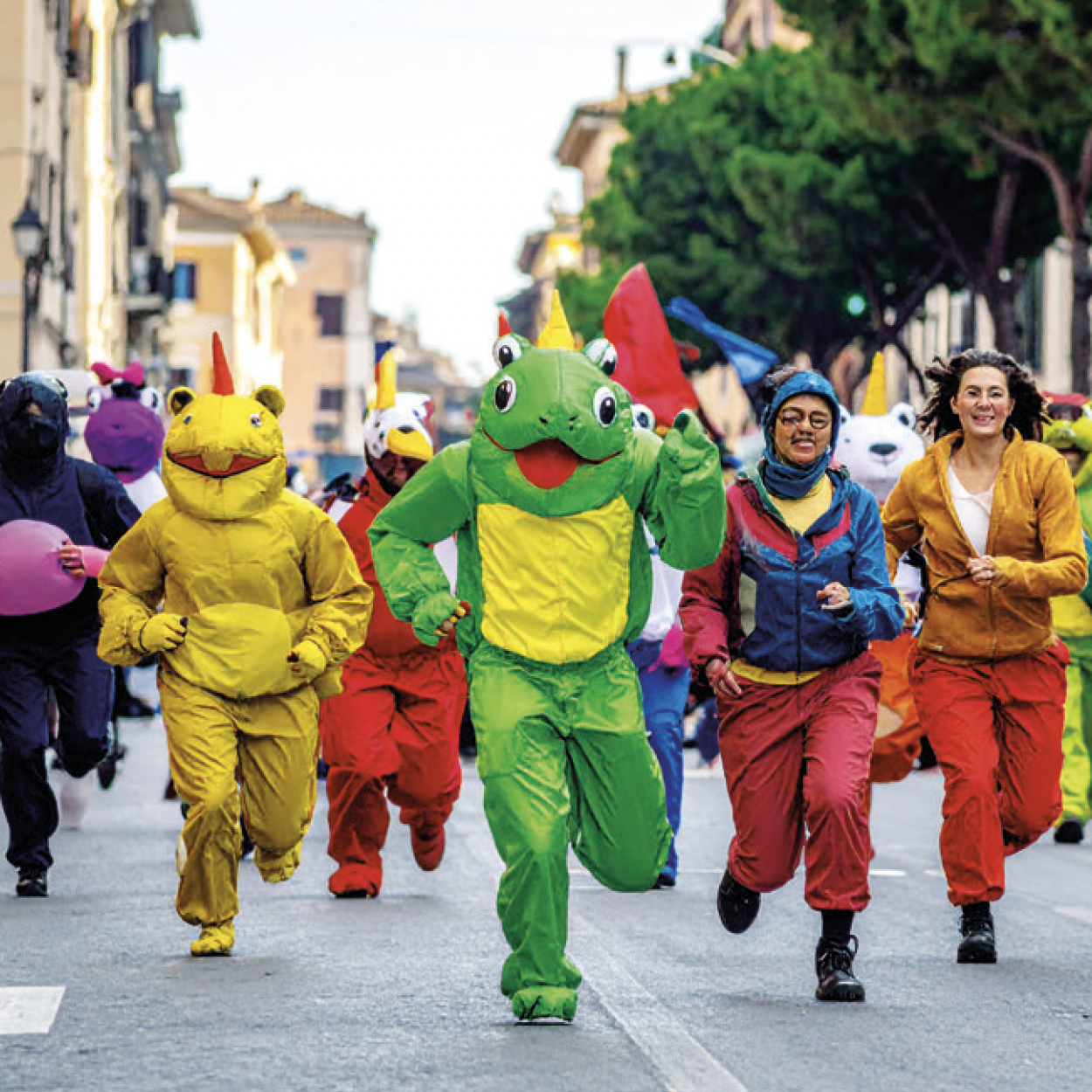
Colamedici, A. (2025). Come battere (davvero) Trump vestiti da polli, rane e dinosauri: la gioia radicale contro il potere sovrano. Tlon. https://www.tlonletter.it/p/come-battere-davvero-trump-vestiti
Comolli, J.-L. (1980). Technique and ideology. The cinematic apparatus (pp. 121-142). Macmillan Press.
Connelly, E. (2025). Federal government's growing banned words list is chilling act of censorship. PEN America. https://pen.org/banned-words-list
Consigliere, S. (2024). Fables of re-enchantment: multiplicity, imaginary, revolution. Minor Compositions.
De Martino, E. (1959). Sud e magia. Feltrinelli.
Deleuze, G., & Guattari, F. (1980). Mille plateaux. Les Éditions de Minuit.
Fisher, M. (2009). Capitalist realism: is there no alternative? Zero Books.
Florensky, P. (2020). La prospettiva rovesciata. Adelphi Edizioni.
Freedberg, D. (1989). The power of images: studies in the history and theory of response. University of Chicago Press.
Gibson, J. J. (1979). The ecological approach to visual perception. Houghton Mifflin and company.
Gnoli, A. (2015, September 6). Non ho voluto seguire i sogni né mi sono mai sentito un artista. La Repubblica. https://www.repubblica.it/cultura/2015/09/07/news/enzo_mari_non_ho_voluto_seguire_i_sogni_ne_mi_sono_mai_sentito_un_artista_-122375033/
Goodman, N. (1978). Ways of worldmaking. Hackett Publishing.
Haraway, D. J. (2016). Staying with the trouble: making kin in the Chthulucene. Duke University Press.
Ippolita. (2024). Hacking del sé: disertare il capitalismo del controllo. Agenzia X.
Koyré, A. (2000). Dal mondo del pressappoco all'universo della precisione. Piccola Biblioteca Einaudi.
Le Bon, G. (1895). Psychologie des foules. Félix Alcan.
Lewis, P. (2017, October 6). 'Our minds can be hijacked': the tech insiders who fear a smartphone dystopia. The Guardian. https://www.theguardian.com/technology/2017/oct/05/smartphone-addiction-silicon-valley-dystopia
McLuhan, M. (1997). The agenbite of outwit. Marshall McLuhan Studies, 1(2). https://mcluhan-studies.artsci.utoronto.ca/v1_iss2/1_2art6.htm
Mendini, A. (1980). Elogio del banale. Oggetto Banale, I Mostra internazionale di architettura, Biennale di Venezia [Catalogo].
Mnouchkine, A. (2003, September 10). Disneyland Resort Paris. Time. https://content.time.com/time/specials/packages/article/0%2C28804%2C2024035_2024499_2024904%2C00.html
Operation Inflation. (2025). https://www.operationinflation.com
Orlowski, A. (2007, November 20). Adam Curtis: the TV elite has lost the plot. The Register. https://www.theregister.com/2007/11/20/adam_curtis_interview/?page=1
Orta, J. (1994). The return of the utopias: the aesthetics of ethics, a draft manifesto for the third millennium. Unpublished manuscript.
Rovelli, C. (2014). Sette brevi lezioni di fisica. Adelphi.
von Uexküll, J. (2010). A foray into the worlds of animals and humans: With a theory of meaning. University of Minnesota Press.
Downloads
Published
Issue
Section
License
Copyright (c) 2026 Progetto Grafico Journal

This work is licensed under a Creative Commons Attribution-NonCommercial-ShareAlike 4.0 International License.