aking Conflict Visible
Visual Communication Design as a Critical, Pedagogical, and Political Practice
DOI:
https://doi.org/10.82068/pgjournal.2026.23.42.11Keywords:
Collective Mapping, Critical Cartography, Transformative Learning, Design Literacy, Transdisciplinary TeachingAbstract
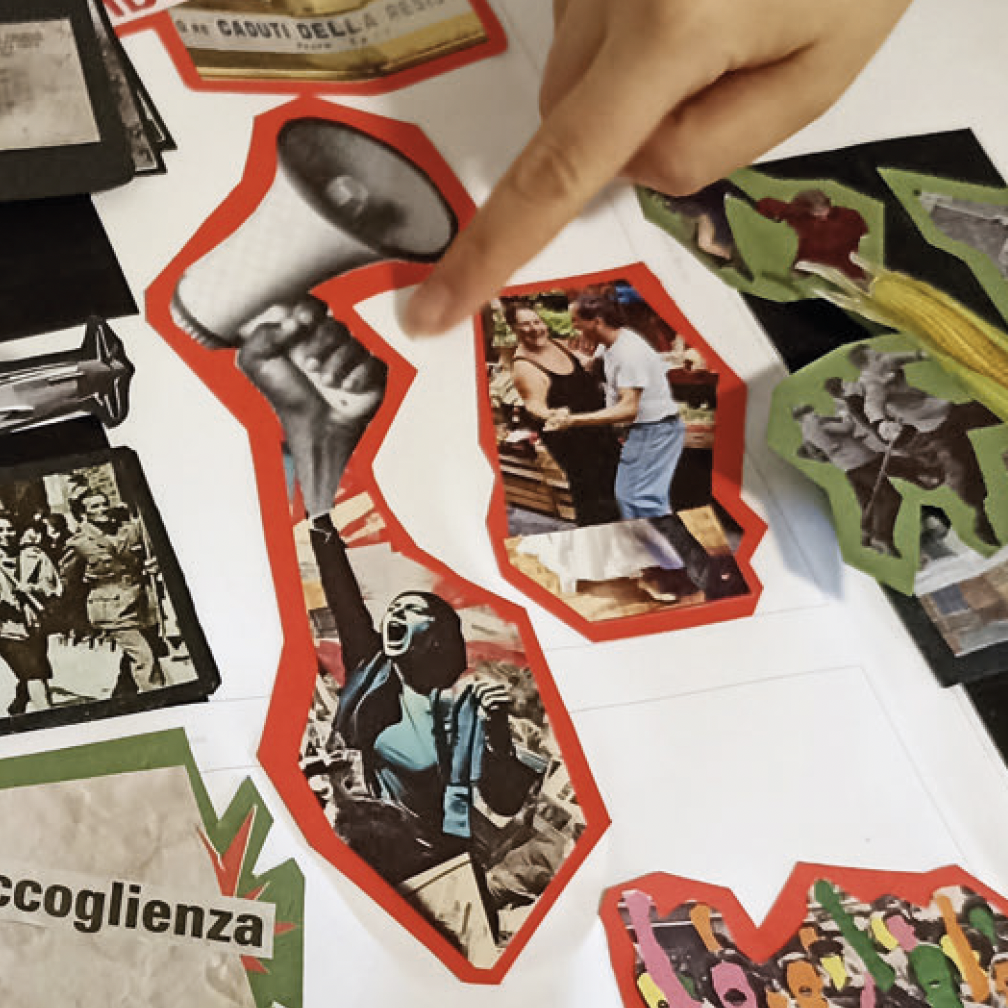
This article investigates the potential of visual communication design as a critical, pedagogical, and political practice. It outlines a theoretical framework that conceptualizes design as an agonistic and reflexive practice aimed at making visible the tensions and conflicts that structure the public sphere. The research is developed through a design-based experiment conducted within the Critical and Collective Mapping workshop at the University of Padua. The experience, which involved geography students, demonstrates how the use of specific design devices — graphic tools intended to facilitate dialogue and collective design — can activate processes of transformative learning and foster the development of critical design literacy. Drawing on qualitative and autoethnographic methods, the study shows how collective mapping practices and the associated graphic design processes can function as forms of critical reappropriation of lived space.
References
Adil, R. (2022). Use of images to support critical visual literacy. Thinking Skills and Creativity, 45, 101046.
Akama, Y., & Yee, J. (2019). Embracing plurality in designing social innovation practices. Design and Culture, 11(1), 1–11.
Cairo, A. (2020). Come i grafici mentono: capire meglio le informazioni visive. Raffaello Cortina Editore.
Crampton, J. W. (2011). Mapping: A critical introduction to cartography and GIS. John Wiley & Sons.
D'Ignazio, C., & Klein, L. (2020). Data feminism. MIT Press
DiSalvo, C. (2012). Adversarial design. MIT Press.
DiSalvo, C. (2019). Design, democrazia e pluralismo agonistico. In A. Facchetti (Ed.), Design & Conflicts (pp. 4–23). Krisis Publishing.
Drucker, J. (2014). Knowledge design: A conceptual and curricular challenge. Design and Culture, 6(1), 65-83.
Ehn, P. (2008). Participation in design things. In Participatory Design Conference (pp. 92–101). ACM Digital Library.
Escobar, A. (2018). Designs for the pluriverse: Radical interdependence, autonomy, and the making of worlds. Duke University Press.
Facchetti, A. (2019). Introduzione. In A. Facchetti (Ed.), Design & Conflicts (pp. 4–23). Krisis Publishing.
Freire, P. (2011). Pedagogia degli oppressi. Edizioni Gruppo Abele.
Fry, T. (2009). Design futuring. University of New South Wales Press.
Grove, K., Krivý, M., Rickards, L., Schliwa, G., Collier, S. J., Cox, S., & Gandy, M. (2019). Interventions on design and political geography. Political Geography, 74, 102017.
Hall, P. (2019). Bolle, linee e stringhe. In che modo la data visualization informa la realtà. In A. Facchetti (Ed.), Design & Conflicts (pp. 4–23). Krisis Publishing.
Haraway, D. (2013). Situated knowledges: The science question in feminism and the privilege of partial perspective 1. In Women, science, and technology (pp. 455-472). Routledge.
Hawkins, H. (2015). Creative geographic methods: Knowing, representing, intervening. Cultural Geographies, 22(2), 247–268.
Harley, J. B. (1989). Deconstructing the map. Cartographica, 26(2), 1–20.
Harvey, D. (1992). Social justice, postmodernism and the city. International Journal of Urban & Regional Research, 16(4), 588–601.
Iconoclasistas. (2021). New devices for thinking the common. FIELD: A Journal of Socially-Engaged Art Criticism.
Iconoclasistas, D. (2022). Organic methodology and feelthink machines. Revista Heterotopías, FFyH, UNC.
Kolb, A. Y., & Kolb, D. A. (2006). Learning styles and learning spaces: A review of the multidisciplinary application of experiential learning theory in higher education. In Learning styles and learning: A key to meeting the accountability demands in education (pp. 45–91).
Latour, B. (2017). Facing Gaia: Eight lectures on the new climatic regime. John Wiley & Sons.
Light, A. (2019). Design and social innovation at the margins: Finding and making cultures of plurality (Version 1). University of Sussex.
Mang, P., & Reed, B. (2012). Designing from place: A regenerative framework and methodology. Building Research & Information, 40(1), 23–38.
Massey, D. (2005). For space. Sage.
McCoy, K. (2003). Good citizenship: Design as a social force. In V. Vienne & S. Heller (Eds.), Citizen designer: Perspectives on design responsibility. Allworth Press.
Mezirow, J. (2008). An overview on transformative learning. Lifelong Learning, 40–54.
Mouffe, C. (2019). Arte e democrazia. Arte come intervento agonistico nello spazio pubblico. In A. Facchetti (Ed.), Design & Conflicts (pp. 4–23). Krisis Publishing.
Novoa, M. (2022). Insurgent heritage: Mobilizing memory, place‐based care and cultural citizenships. International Journal of Urban and Regional Research, 46(6), 1016–1034.
Pinotti, A., & Somaini, A. (2016). Cultura visuale: immagini, sguardi, media, dispositivi (Vol. 653). Einaudi.
Schweizer, P., Halder, S., & kollektiv orangotango. (2024). Don’t believe the mapping hype! Three steps back for an engaged cartography. In The Routledge Handbook of Cartographic Humanities (pp. 54–60). Routledge.
Swann, C. (2002). Action research and the practice of design. Design Issues, 18(1), 49–61.
Von Benzon, N., Wilkinson, S., Wilkinson, C., & Holton, M. (2021). Creative methods for human geographers. Sage Publishing.
Downloads
Published
Issue
Section
License
Copyright (c) 2026 Progetto Grafico Journal

This work is licensed under a Creative Commons Attribution-NonCommercial-ShareAlike 4.0 International License.