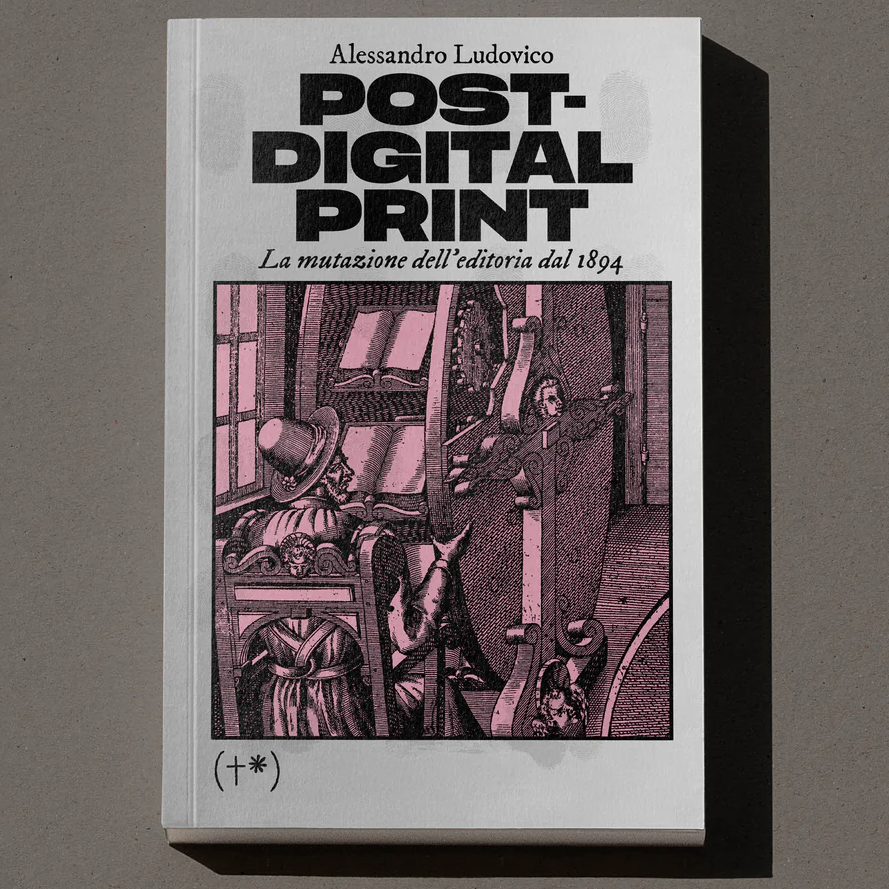
Post-Digital Print
La mutazione dell'editoria dal 1894 (Ludovico, 2025)
DOI:
https://doi.org/10.82068/pgjournal.2026.23.42.15Abstract
The review traces the editorial history and critical project of Alessandro Ludovico's Post-digital print, now in its second Italian edition (Timeo, 2025), following a deliberately hybrid first distribution: released as a PDF on pen drives and in open-access format even before the printed version appeared, the book enacts in its own mode of dissemination the very argument it advances. Ludovico does not read print as a relic of the past, but as a versatile medium continuously redefining itself in dialogue with the digital: the post-digital horizon is one in which analog and digital coexist, contaminate each other, and multiply — from early twentieth-century avant-garde print to underground publications, from mimeographed zines to print-on-demand platforms. The review highlights the book's political and emancipatory value: ink and pixel do not exclude but reinforce each other, and print — in its slowness, its physicality, its spatial and temporal invariance — takes on the character of a material resistance to the volatility of the digital sphere and the fragmentation of knowledge.
References
Blissett, L. (2000). Q (Nuova ed.). Einaudi.
Blissett, L. (2003). Q. Translated from the Italian by Shaun Whiteside. William Heinemann
The Random House Group Limited.
Burdick, A., Drucker, J., Lunenfeld, P., Presner, T. & Schnapp, J. (2014). The Immense Promise of the Digital Humanities. The New Republic. In A. Ludovico, A. (2015), Le reti come agenti
nello scontro tra stampa post-digitale personale e industriale. Progetto grafico. Pubblicare, 13(28), pp. 28–39. http://www.newrepublic.com/article/117711/digital-humanitieshave-immense-promise-response-adam-kirsh
Ludovico, A. (2012). Post-Digital Print. The Mutation of Publishing Since 1894. Onomatopee. https://monoskop.org/images/a/a6/Ludovico,_Alessandro_-_Post-Digital_Print._The_Mutation_of_Publishing_Since_1894.pdf
Ludovico, A. (2015). Le reti come agenti nello scontro tra stampa post-digitale personale e industriale. Progetto grafico. Pubblicare, 13(28), 28–39. https://aiap.it/cdpg/numero/progetto-grafico-n-28/
Ludovico, A. (2025). Post-digital print. La mutazione dell'editoria dal 1894. Traduzione di Arcangelo Licinio. Timeo.
Monoskop. (n.d.). https://monoskop.org/Monoskop
Onomatopee. (n.d.). https://www.onomatopee.net/
Piscitelli, D. (2019). First things first. Comunicare le emergenze. Il design per una contemporaneità fragile. LISTLab.
Downloads
Published
Issue
Section
License
Copyright (c) 2026 Progetto Grafico Journal

This work is licensed under a Creative Commons Attribution-NonCommercial-ShareAlike 4.0 International License.