Writing Models for Incomplete Archives
Design Philology and the Reconstruction of Partial Memories
DOI:
https://doi.org/10.82068/pgjournal.2025.22.41.10Keywords:
Memory Writings, Digital Archives, Relational Ontology, Curatorial Narration, Institutional MemoryAbstract
Collective memory is not a collection of documents and recollections, but an active, selective, and often fragmentary construction. Archives, as cultural devices, do not merely preserve: they articulate what is remembered and what can be forgotten. This contribution investigates how, in the context of digital writing practices, such strategies of recording can generate models that weave together memories, testimonies, documents, and interpretations, involving both people and materials. From this perspective, we present Design Philology, an experimental platform for archiving, exploration, and narration developed by the Department of Design at Politecnico di Milano. The platform investigates the potential of the archive as a space for open and plural writing, assuming partiality as a generative condition.
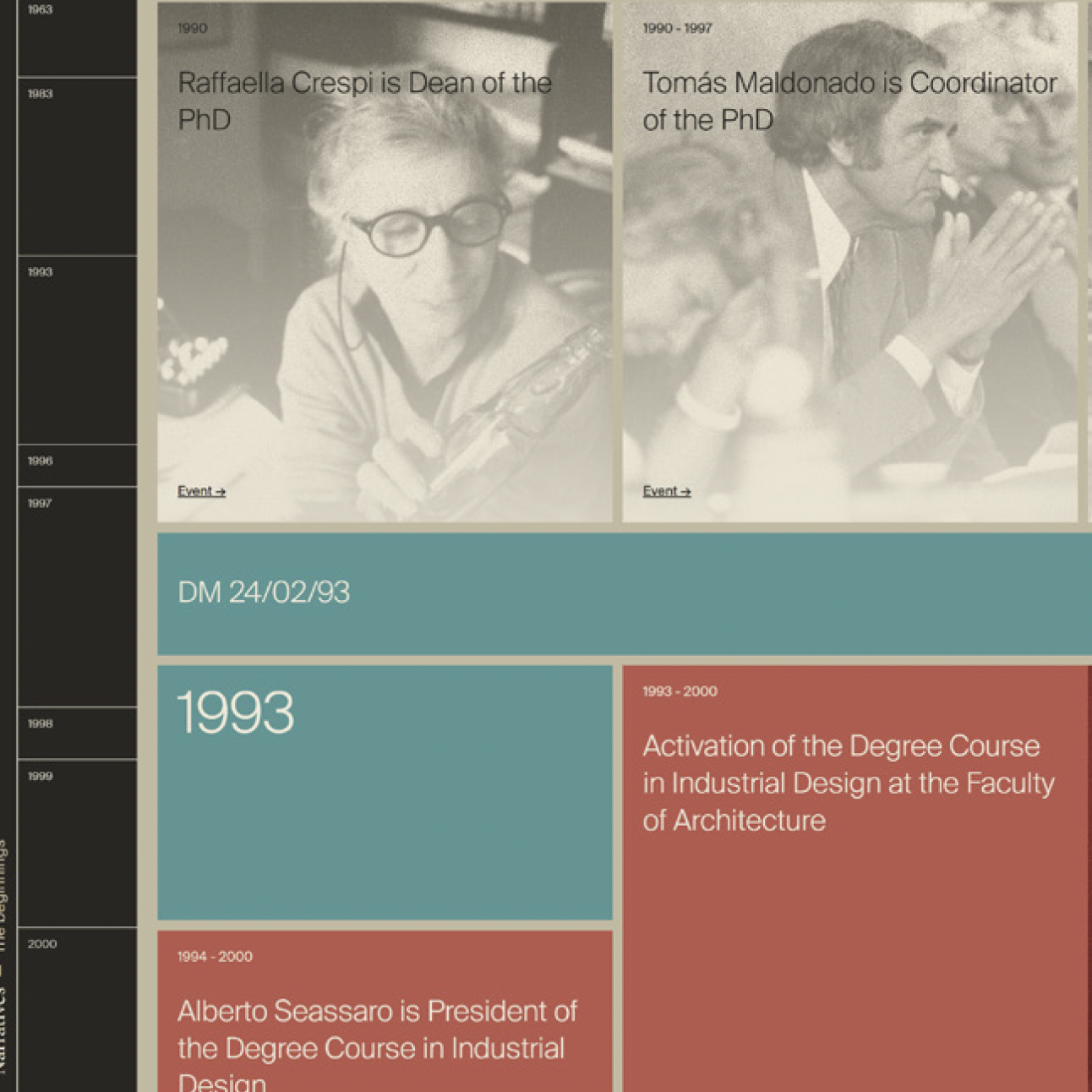
The analysis focuses on the authorial sections of the archive (Narrazioni and Timeline) where the interface takes on a curatorial role, enabling the construction of interpretive and narrative paths. In these sections, the writing model allows authors to rewrite the archive through operations of montage, juxtaposition, and the articulation of relationships between contents. Archival materials, images, paratexts, institutional documents, personal testimonies, and multimedia contributions combine across different temporal and relational layers, giving shape to compositions that make visible thematic, biographical, or personal perspectives, and to partial and plural forms of memory-writing.
In this context, Design Philology positions itself as an experimental prototype of digital mnēmography: an attempt to write institutional memory by exploring the complexity, incompleteness, and partiality of archival materials, as well as the multiplicity of those who have lived, interpreted, and transmitted this history.
References
Allyn, N. E., Aubitz, S., & Stern, G. F. (2010). Using archival materials effectively in museum exhibitions. American Archivist. https://doi.org/10.17723/AARC.50.3.G5203123461G2208
Barthes, R. (1966). Introduction à l’analyse structurale des récits. Communications, 8(1), 1–27. https://doi.org/10.3406/comm.1966.1113
Bearman, D. (1989). Archives and museum data model and dictionary. Archives and Museum Informatics, 3. https://doi.org/10.1007/BF02875919
Bertola, P., Bosoni, G., & Rebaglio, A. (Eds.). (2024). Design Philology Essays. Issue Zero. Design at Politecnico di Milano: The Beginning of a Story. FrancoAngeli.
Cook, T. (2013). Evidence, memory, identity, and community: Four shifting archival paradigms. Archival Science, 13(2–3), 95–120. https://doi.org/10.1007/s10502-012-9180-7
Derrida, J. (1995). Mal d’archive: Une impression freudienne. Galilée.
Design Philology. (2024). https://designphilology.polimi.it
Drucker, J. (2014). Graphesis: Visual forms of knowledge production. Harvard University Press.
Ferreira-Lopes, P. (2020). A data-driven approach for architectural history knowledge: Capturing buildings’ construction events for historical research collaboration. Journal on Computing and Cultural Heritage (JOCCH), 13, 1–22. https://doi.org/10.1145/3376925
Foucault, M. (1969). L’archeologia del sapere. Rizzoli.
Franks, P. C. (Ed.). (2021). The handbook of archival practice. Rowman & Littlefield Publishers.
Galison, P. (1997). Image and logic: A material culture of microphysics. University of Chicago Press.
Ginzburg, C., Tedeschi, J., & Tedeschi, A. C. (1993). Microhistory: Two or three things that I know about it. Critical Inquiry, 20(1), 10–35. https://doi.org/10.1086/448699
Halbwachs, M. (1992). On collective memory. University of Chicago Press.
Harris, V. (2007). Archives and justice: A South African perspective. Society of American Archivists.
Ketelaar, E. (2008). Archives as spaces of memory. Journal of the Society of Archivists, 29(1), 9–27. https://doi.org/10.1080/00379810802499678
Lowenthal, D. (2015). The past is a foreign country. Cambridge University Press. https://doi.org/10.1017/CBO9781139024884
Ludovico, A. (2014). Post-digital print. La mutazione dell’editoria dal 1894. CaratteriMobili.
Quaggiotto, M. (2012). Cartografie del sapere. Interfacce per l’accesso agli spazi della conoscenza. FrancoAngeli.
Rickards, M., & Twyman, M. (2000). Encyclopedia of ephemera: A guide to the fragmentary documents of everyday life for the collector, curator and historian. Routledge.
Rosenberg, D., & Grafton, A. (2013). Cartographies of time: A history of the timeline. Princeton Architectural Press.
Sabharwal, A. (2021). Functional frameworks for socialized digital curation: Curatorial interventions and curation spaces in archives and libraries. Library Trends, 69, 672–695. https://doi.org/10.1353/lib.2021.0009
Downloads
Published
Issue
Section
License
Copyright (c) 2025 Progetto Grafico Journal

This work is licensed under a Creative Commons Attribution-NonCommercial-ShareAlike 4.0 International License.