ELDERLY-SENSITIVE EDITORIAL TRANSLATIONS
A RESEARCH PROJECT TO PROMOTE THE ACCESSIBILITY AND READABILITY OF TEXTS
DOI:
https://doi.org/10.82068/pgjournal.2025.22.41.17Keywords:
Editorial accessibility, Legibility, Editorial translation, Readers over 65, MicrotypographyAbstract
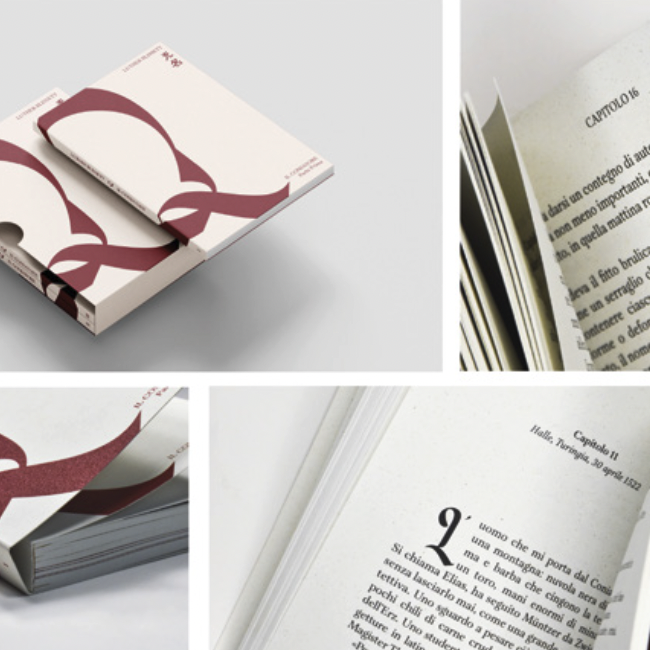
The research illustrates a methodological approach aimed at highlighting some factors useful for the design of accessible publishing artefacts intended primarily, but not exclusively, for readers over the age of 65. After a critical review of multiple contributions on microtypography, visual ergonomics and publishing translation, 100 cases of good practice were surveyed, highlighting the scarcity of volumes designed for the elderly. An initial experimental workshop in the !eld of education involved designers and students in processes of intrasemiotic and intersemiotic translation of the historical novel Q, which, due to its peculiarities, lends itself to linguistic transfer processes. This initial experiment led to a second empirical study aimed at modelling three meta-volumes that differ from each other in terms of text and iconography.
The overall results confirm the multifactorial nature of legibility: body, line spacing, contrast, layout, support and orientation devices must work in synergy. Understanding editorial design as a translational process — intralinguistic, intersemiotic and ethical — allows for the integration of multiple sensory channels without impoverishing the overall meaning of the source text. The direct involvement of readers over the age of 65, taken as model readers, proves decisive in avoiding stigmatising solutions and enhancing the quality of a reading experience open to all. On a theoretical level, the research combines issues related to accessibility in the reading process, editorial translation practices, and knowledge related to typography and microtypography, proposing a concept of the book as a polyalphabetic text. Further developments may concern possible hybridisations between paper formats and products generated by generative artificial intelligence for the dynamic customisation of layouts and content.
References
Associazione Italiana Editori. (2023, 18 ottobre). Rapporto sullo stato dell’editoria in Italia 2023 (presented at the Frankfurter Buchmesse). https://www.aie.it/Portals/_default/Skede/Allegati/Skeda105-9398-2023.10.18/Rapporto%20sullo%20stato%20dell’editoria%202023.pdf?IDUNI=j0nxcvjz5lrmtdtjqbz2m5fx6622
Abbate, C., Luzzatti, C., & Vergani, C. (2007). Test delle matrici: velocità e accuratezza della ricerca visiva nel corso dell’invecchiamento [Matrix test: Speed and accuracy of visual search in aging]. Giornale di Gerontologia, 55(1), 11–20. https://doi.org/10.1155/2007/30873
Bandinelli, A., Lussu, G., & Iacobelli, R. (1990). Farsi un libro: Propedeutica dell’autoproduzione. Stampa Alternativa.
Baracco, L. (2008). Questione di leggibilità: Se non riesco a leggere non è solo colpa dei miei occhi [Project]. Comune di Venezia.
Barthes, R. (1977). From work to text. In S. Heath (Ed. & Trans.), Image, music, text (pp. 155–164). Hill and Wang.
Baule, G., & Caratti, E. (Eds.). (2016). Design è traduzione: Il paradigma traduttivo per la cultura del progetto. FrancoAngeli.
Beier, S. (2011). Reading letters: Designing for legibility. BIS Publishers.
Beier, S. (2021a). Type tricks: Layout design. BIS Publishers.
Beier, S. (2021b). Type tricks: Your personal guide to type design. BIS Publishers.
Beier, S. (2022). Type tricks: User design. BIS Publishers.
Beier, S., & Larson, K. (2010). Design improvements for frequently misrecognized letters. Information Design Journal, 18(2), 118–137.
Bigelow, C., & Matteson, S. (2011). Font improvements in cockpit displays and their relevance to automobile safety(Unpublished conference paper).
Bucchetti, V. (Ed.). (2024). Design della comunicazione: Un ritratto disciplinare: studi e traiettorie. FrancoAngeli.
Caratti, E. (2024a). Ethical translations for social design. In E. Caratti & L. Galluzzo (Eds.), Designing ethically in a complex world: Multiple challenges within design for public and social systems (pp. 55–66). FrancoAngeli.
Caratti, E. (2024b). La dimensione traduttiva come registro progettuale: Discipline in divenire. In V. Bucchetti (Ed.), Design della comunicazione: Un ritratto disciplinare: studi e traiettorie (pp. 66–78). FrancoAngeli.
Carter, H. (Ed.). (1930). Fournier on typefounding: The text of the “Manuel typographique” (English translation). Soncino Press.
Castellano, A. (2022). Leggi[a]bilità, tra grafica e inclusione / Legi[a]bility, from graphic design to inclusion. In C. Battini & E. Bistagnino (Eds.), Dialoghi. Visioni e visualità … Proceedings of the 43rd International Conference of Representation Disciplines Teachers (pp. 1374–1385). FrancoAngeli.
Cattell, J. M. (1886). The time it takes to see and name objects. Mind, 11(41), 63–65. https://doi.org/10.1093/mind/os-XI.41.63
Chung, S. T. L., & Mansfield, J. S. (2009). Contrast polarity differences reduce crowding but do not benefit reading performance in peripheral vision. Vision Research, 49, 2782–2789. https://doi.org/10.1016/j.visres.2009.08.013
Direzione Generale Sanità e Politiche Sociali, Regione Emilia-Romagna. (2014, giugno). Ali Ascoltalibri: Sperimentare attività innovative nell’ambito dei centri socio-riabilitativi per disabili. https://sociale.regione.emilia-romagna.it/
Eco, U. (2002). Lector in fabula: La cooperazione interpretativa nei testi narrativi. Bompiani.
Fournier, P. S. (2018). Manuel typographique. Hachette Livre–BnF.
Hartley, J., Burnhill, P., & Davis, L. (1978). Retrieval of information from prose text. Visible Language, 12(2), 183–194.
Hochuli, J. (2018). Il dettaglio in tipografia. Lazy Dog.
Lupton, E. (2004). Thinking with type: A critical guide for designers, writers, editors & students. Princeton Architectural Press.
Noordzij, G. (2005). The stroke: Theory of writing. Hyphen Press.
Perondi, L. (2024). L’alta leggibilità (non) esiste? Cosa significa progettare un testo graficamente inclusivo. Nomos Edizioni.
Riccò, D. (2024a). Accessibilità nel design della comunicazione: Origini, significato, applicazioni. In M. C. Andriello & D. Riccò (Eds.), Comunicazione accessibile: Progettare contenuti per tutti (pp. 47–68). Rai Libri.
Riccò, D. (2024b). Accessibilità comunicativa: Qualificare le competenze. In V. Bucchetti (Ed.), Design della comunicazione: Un ritratto disciplinare: studi e traiettorie (pp. 79–92). FrancoAngeli.
Schaik, P., & Ling, J. (2011). An integrated model of interaction experience for information retrieval in a web-based encyclopaedia. Interacting with Computers, 23, 18–32. https://doi.org/10.1016/j.intcom.2010.07.002
Slattery, T. J., & Parker, A. J. (2019). Return sweeps in reading: Processing implications of undersweep fixations. Psychonomic Bulletin & Review, 26, 1948–1957. https://doi.org/10.3758/s13423-019-01636-3
Tracy, W. (1986). Letters of credit: A view of type design. Gordon Fraser.
Tracy, W. (1990). The typographic scene. Ashgate.
Unger, G. (2006). Il gioco della lettura. Stampa Alternativa & Graffiti.
Downloads
Issue
Section
License
Copyright (c) 2025 Progetto Grafico Journal

This work is licensed under a Creative Commons Attribution-NonCommercial-ShareAlike 4.0 International License.