Il ruolo delle cooperative nel design della comunicazione in Italia
DOI:
https://doi.org/10.82068/pgjournal.2026.23.42.13Abstract
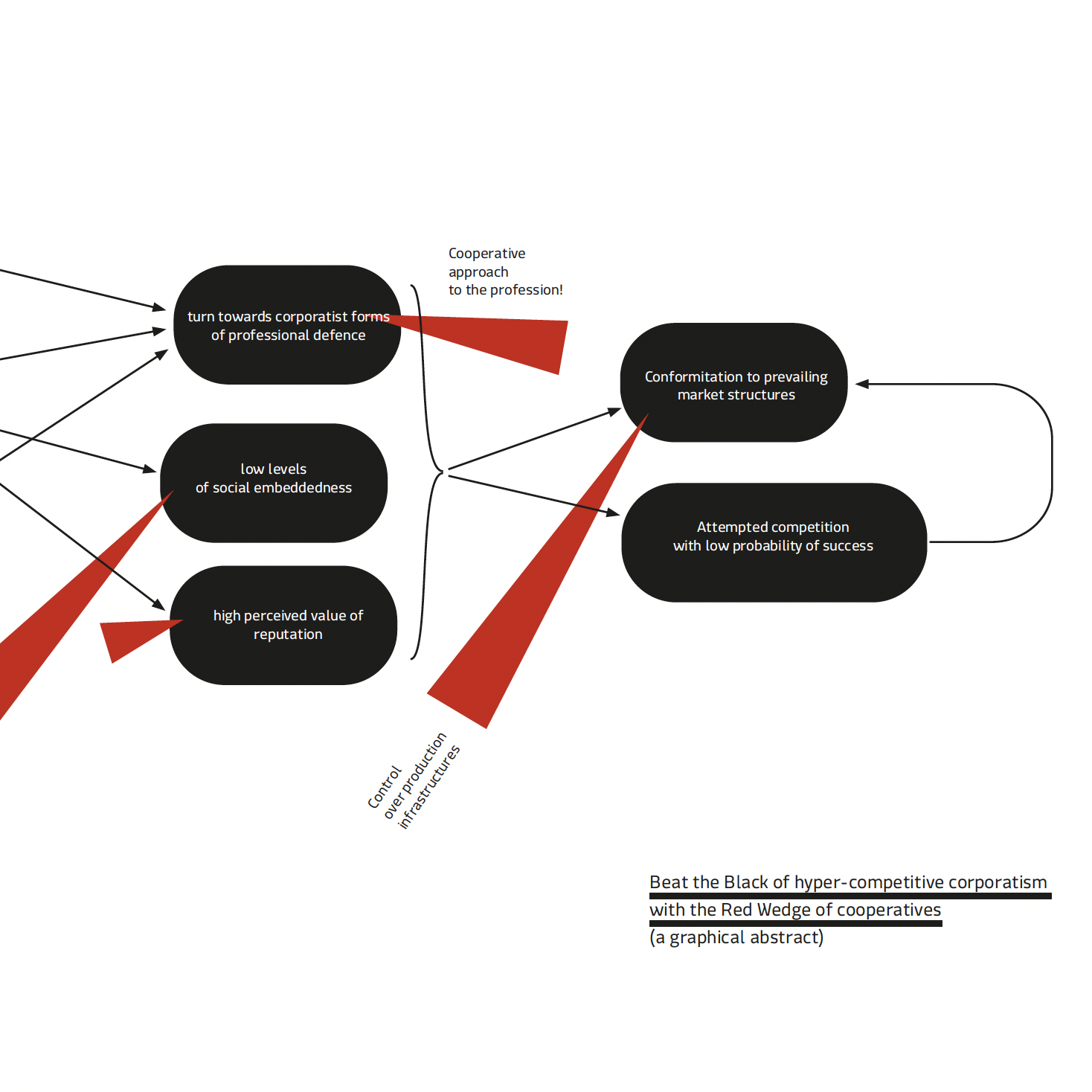
Le cooperative offrono un modello di design della comunicazione che rimedia strutturalmente all'eccessiva frammentazione del mercato. Questa frammentazione lascia una moltitudine di freelance in uno stato di competizione reputazionale, ma privi di un'adeguata tutela aziendale e di potere contrattuale. La governance democratica delle cooperative garantisce che le ambizioni dei professionisti siano in linea con gli obiettivi dell'organizzazione. Il settore italiano del design della comunicazione è composto principalmente da microimprese con limitato potere contrattuale, nonché da professionisti indipendenti che operano individualmente. Un canale secondario, caratterizzato da social media e piattaforme per freelance, offre spesso pagamenti simbolici e capitale reputazionale che non si traducono in un reddito stabile. Le cooperative offrono un'alternativa pratica ai modelli tradizionali, in quanto condividono i rischi tra i soci, contribuendo così a garantire redditi stabili e a tutelare i diritti.
Riferimenti bibliografici
Barberini, I. (2019). Identità e valori dell’impresa cooperativa: Scritti e discorsi scelti di Ivano Barberini, presidente dell’International Co-operative Alliance (2001–2009) (M. Dorigatti & T. Menzani, Eds.). Rubbettino.
Bellini, A., Burroni, L., & Dorigatti, L. (2018). Industrial Relations and Creative Workers. Country Report: Italy (Work Package C) (IR-CREA – Strategic but Vulnerable. Industrial Relations and Creative Workers, p. 114). European Commission. http://hdl.handle.net/2158/1134947
Borzaga, C., & Depedri, S. (2007). Relazioni interpersonali e soddisfazione per il lavoro: Alcuni risultati empirici nel settore dei servizi sociali. Impresa Sociale, 76(2), 79–97.
Borzaga, C., Calzaroni, M., Carini, C., & Lori, M. (2019). Italian cooperatives: An analysis of their economic performances, employment characteristics and innovation processes based on combined use of official data. http://hdl.handle.net/11159/3142
Borzaga, C., Depedri, S., & Bodini, R. (2010). Cooperatives: The Italian experience. Euricse Working Paper No. 006|10.
Bourdieu, P. (1986). The forms of capital. In J. Richardson (Ed.), Handbook of theory and research for the sociology of education (pp. 241–258). Greenwood.
Chen, S., & Schiele, K. (2017). Positioning SMEs With a Lone Designer: A Qualitative Study of Small Design Firms. Journal of Marketing Theory and Practice, 25(3), 213–233.
https://doi.org/10.1080/10696679.2017.1311217
Cowling, K., & Sugden, R. (1998). The essence of the modern corporation: Markets, strategic decision-making and the theory of the firm. The Manchester School, 66(1), 59–86.
https://doi.org/10.1111/1467-9957.00089
Estrin, S. (1991). Some reflections on self-management, social choice, and reform in Eastern Europe. Journal of Comparative Economics, 15(2), 349–366.
https://doi.org/10.1016/0147-5967(91)90093-9
European Commission, Directorate-General for Internal Market, Industry, Entrepreneurship and SMEs. (2026). SME definition. Internal Market, Industry, Entrepreneurship and SMEs.
https://single-market-economy.ec.europa.eu/smes/sme-fundamentals/sme-definition_en
Filippetti, A. (2011). Innovation modes and design as a source of innovation: A firm‐level analysis. European Journal of Innovation Management, 14(1), 5–26. https://doi.org/10.1108/14601061111104670
Fondazione Symbola, Deloitte Private, POLI.design, & ADI. (2025). Design Economy 2025 (I Quaderni Di Symbola). ISBN 9791281830042. https://symbola.net/ricerca/design-economy-2025/
Granovetter, M. (1985). Economic action and social structure: The problem of embeddedness. American Journal of Sociology, 91(3), 481–510. https://doi.org/10.1086/228311
Gandini, A. (2016). The reputation economy. Palgrave Macmillan.
Gemser, G., & Van Zee, E. (2002). Benchmarking Industrial Design Services. The Design Journal, 5(2), 35–52. https://doi.org/10.2752/146069202790718530
Granata, M. (2019). Breve storia dell’International Co-operative Alliance. In M. Dorigatti & T. Menzani (Eds.), Identità e valori dell’impresa cooperativa: Scritti e discorsi scelti di Ivano Barberini, presidente dell’International Co-operative Alliance (2001–2009) (pp. 25–41). Rubbettino.
International Cooperative Alliance. (2024). Cooperative identity, values & principles. ICA. https://ica.coop/en/whats-co-op/co-operative-identity-values-principles
Lucciarini, S., & Pulignano, V. (2023). Inequalities in Neo-mutualistic Professional Organisations: The Boundary Work of Creative Workers in Italy. In L. Maestripieri & A. Bellini (Eds), Professionalism and Social Change (pp. 209–230). Springer International Publishing. https://doi.org/10.1007/978-3-031-31278-6_10
Mani, D., & Moody, J. (2014). Moving beyond stylized economic network models: The hybrid world of the Indian firm ownership network. American Journal of Sociology, 119(8), 1669–1706.
https://doi.org/10.1086/676040
Menzani, T., & Zamagni, V. (2010). Cooperative networks in the Italian economy. Enterprise & Society, 11(1), 98–127. https://doi.org/10.1093/es/khp029
Merkel, J. (2019). ‘Freelance isn’t free’: Co-working as a critical urban practice to cope with informality in creative labour. Urban Studies, 56(3), 526–547. https://doi.org/10.1177/0042098018779274
Moody, J., & White, D. R. (2003). Structural cohesion and embeddedness: A hierarchical concept of social groups. American Sociological Review, 68(1), 103–127. https://doi.org/10.2307/3088904
Origgi, G. (2015). La réputation: Qui dit quoi de qui. Presses Universitaires de France.
Sabatini, F., Modena, F., & Tortia, E. (2014). Do cooperative enterprises create social trust? Small Business Economics, 42(3), 621–641. https://doi.org/10.1007/s11187-013-9494-8
Vankan, A., Frenken, K., & Castaldi, C. (2014). Designing for a Living? Income Determinants Among Firm Founders in the Dutch Design Sector. Industry and Innovation, 21(2), 117–140.
https://doi.org/10.1080/13662716.2014.896160
Zamagni, S. (2008). Comparing capitalistic and cooperative firms on the ground of humanistic management. In Proceedings of the 1st IESE Conference: Humanizing the Firm & Management Profession.
Zamagni, S., & Zamagni, V. (2011). Cooperative enterprise: Facing the challenge of globalization. Edward Elgar.
Dowloads
Pubblicato
Fascicolo
Sezione
Licenza
Copyright (c) 2026 Progetto Grafico Journal

Questo volume è pubblicato con la licenza Creative Commons Attribuzione - Non commerciale - Condividi allo stesso modo 4.0 Internazionale.